
Hour 0-4: The Data Inventory
Start by mapping what you can actually see. Most teams skip this step and jump straight into analysis, which is why they end up chasing ghosts. You can't audit what you can't measure, and you can't improve what you haven't baselined.
Open a spreadsheet. Create four columns: Data Source, What It Tracks, Date Range Available, Known Gaps. Spend the first hour filling this in across every system you have access to. Google Analytics (or your web analytics tool), CRM, email platform, ad accounts, product analytics, support tickets. If you're in B2B SaaS, include data from your sales team's pipeline reports.
In our experience running these audits, the average mid-market company has tracking blind spots in three predictable places: post-trial behavior (they see signups, not what happens after day seven), cross-device journeys (mobile research converting on desktop), and offline conversions (phone calls, live demos). Document these gaps now because they'll explain anomalies later.
The second two hours are for basic validation. Pull your top-line metrics for the last six months. Revenue, traffic, conversion rates at each major funnel stage, CAC by channel, and churn rate if you're subscription-based. Don't analyze yet; just confirm the numbers match across systems. A Series B company we worked with discovered their GA4 revenue was 18% lower than Stripe because trial conversions weren't firing properly. That's not an insight, that's a data integrity problem, and it needs flagging before you draw conclusions.
Use hour four to calculate three ratios that most dashboards don't show by default:
- Cost per qualified lead (not just cost per lead): Take ad spend divided by leads that meet your ICP criteria. If your CRM doesn't tag lead quality, use a proxy like company size or job title.
- Lead-to-customer timeline: Median days from first touch to closed-won. This tells you how much lag exists in your feedback loops.
- Revenue concentration: What percentage of revenue comes from your top channel, top product, or top customer segment. According to research from Profitwell, B2B SaaS companies with over 60% revenue concentration in one channel face 3x higher risk during platform changes or market shifts.
Hour 4-12: Funnel Forensics
Most funnel analysis starts at the top and works down. That's backward. Start at the point of revenue and work upstream. You're looking for where value gets created, then tracing back to where it gets blocked.
Pull your conversion data for the last 90 days. If you're B2B, this means opportunity-to-customer conversion. If you're e-commerce, it's checkout-to-order. Calculate the conversion rate, then segment it by one variable at a time: traffic source, device type, product category, time-on-site bucket, returning versus new. Don't run multivariate analyses yet; you're hunting for single-variable breaks that are large enough to matter.
One e-commerce brand we audited had an overall cart-to-order conversion rate of 68%, which looked healthy. Segmented by device, desktop was 78%, mobile was 52%. Segmented by product category, apparel converted at 71%, home goods at 48%. The issue wasn't the funnel, it was that mobile traffic skewed toward the lower-converting category. The fix wasn't a mobile redesign, it was adjusting ad targeting to reduce mobile home goods traffic and shift budget to desktop where that category converted better. The point: segment before you diagnose.
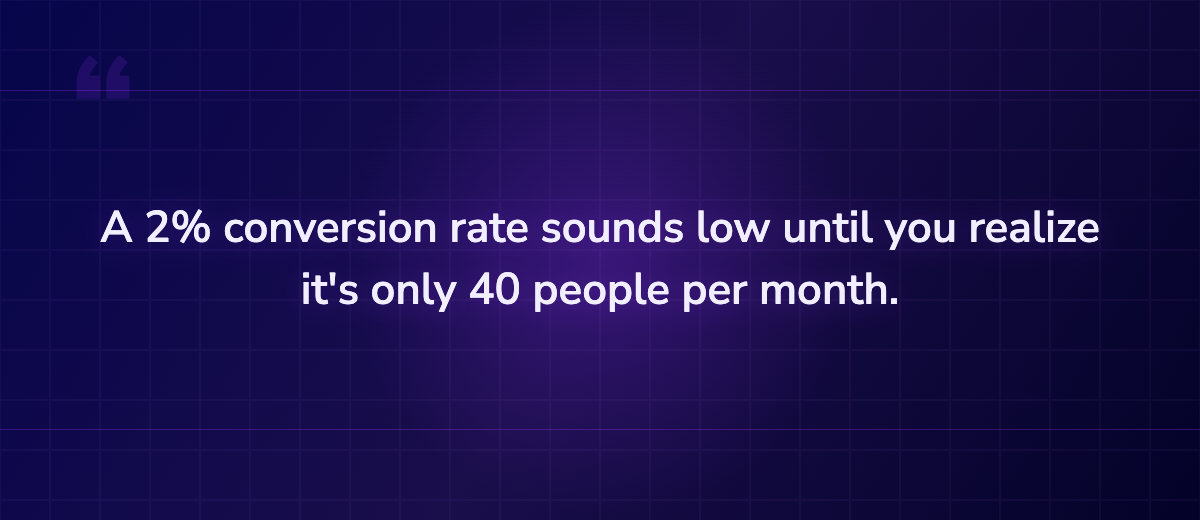
Spend hours six and seven mapping drop-off points. For every major stage in your funnel (visitor to lead, lead to qualified, qualified to opportunity, opportunity to customer), calculate the conversion rate and the absolute drop-off volume. A 2% conversion rate sounds low until you realize it's only 40 people per month. A 45% conversion rate sounds great until you see it's losing 300 opportunities per month. Prioritize based on volume, not just percentages.
In hours eight through ten, reconstruct user paths for your highest-value conversions. If you're using GA4, build an exploration report showing the top paths to purchase for users who spent above your average order value. If you're in B2B, pull the CRM activity log for your last ten closed-won deals. You're looking for commonalities: Did they all hit the pricing page twice? Did they all engage with a specific content asset? Did they all have short time-to-convert or long?
This is where most audits find their first real insight. A B2B SaaS company we worked with discovered that deals closing in under 30 days almost always included a live demo in the first week, while deals taking over 60 days had a demo scheduled in week three or later. The insight wasn't "do more demos"; it was "get the demo scheduled earlier." The sales team was treating demos as a middle-funnel activity when the data showed it was an early signal of intent.
Hours eleven and twelve are for anomaly hunting. Sort your conversion data by week or month and look for spikes or drops that don't align with campaign launches or seasonality. Pull qualitative data from the same period: support tickets, user feedback, product releases. Studies from Amplitude suggest that unexplained conversion drops are tied to product bugs or payment friction about 40% of the time, and to targeting drift (campaigns pulling in lower-intent traffic) another 30% of the time.
If you're stuck, filter by your best-performing segment (highest LTV customers or highest AOV orders) and compare their behavior to everyone else. The gaps between power users and average users are where leverage hides.
Hour 12-24: Channel Deep Dive
Channel analysis isn't about which channel drives the most traffic, it's about which one creates the most enterprise value per dollar and per hour of team effort. That requires looking at full-funnel economics, not just top-of-funnel volume.
Start by building a simple channel scorecard. List every channel where you're actively spending time or money: paid search, paid social, organic search, email, content, partnerships, referrals. For each one, pull four metrics: traffic volume, cost (including team time valued at hourly rates if there's no media spend), conversion rate to revenue, and customer LTV by source if your attribution allows it.
The tradeoff here is that attribution models are useful for directional patterns, but they're systematically misleading when used for precise budget allocation. Post-iOS 14.5, we've typically seen mobile conversion tracking under-report by 15-30% in paid social campaigns. If your attribution is last-click or even data-driven modeling through Google Analytics, you're getting an approximation, not truth. Acknowledge that in your conclusions.
In our experience, three channels consistently get misread:
- Organic search looks efficient because it has no media cost, but if you're running an aggressive content program, the team cost per lead can exceed paid search once you factor in production time.
- Paid social often shows weak last-click attribution but strong influence on branded search and direct traffic, especially in B2B where buying cycles are long and multi-touch.
- Email to existing customers shows incredible conversion rates but doesn't scale. It's retention, not acquisition, and confusing the two is how companies over-rotate on lifecycle marketing while acquisition stalls.
Look for three specific patterns:
- Efficiency cliffs: At what spend level does your CPA start rising sharply? That's where you're exhausting high-intent audience segments and spilling into colder traffic.
- Creative decay: How long do your top ads maintain performance before CTR drops? According to data from Metadata, B2B ads typically see a 20-30% CTR decline after 10-14 days in the same audience.
- Audience saturation: Pull frequency data from Facebook or Google. If average frequency is above 3 in a 30-day window, you're over-exposing, which kills performance and annoys users.
Hours seventeen through twenty are for content and lifecycle channel analysis. If you run email campaigns, pull open rates, click rates, and conversion rates segmented by campaign type (nurture, product, promotional). Calculate revenue per email send. Most teams discover they're over-mailing; one SaaS company we audited was sending 14 emails per month to trial users, and reducing it to 6 higher-value emails increased trial-to-paid conversion by 11%.
If content marketing is a channel, audit your top 20 posts by traffic. How many of them drive conversions, not just visits? Use GA4 or your analytics tool to see which posts have the highest visit-to-lead rate. The gap between your most-visited and most-converting content is where your editorial strategy is misaligned with business outcomes.
Spend hours twenty-one through twenty-four on cross-channel analysis. This is where privacy changes have made things harder. You can't track users across platforms the way you could pre-2021, but you can look for patterns in aggregate data. For example, if paid social spend increases by 30% in a given month and branded search volume increases by 20% the following month, there's likely a halo effect even if attribution doesn't connect the dots.
One mobile app company we worked with saw paid social conversions drop 40% after iOS 14.5, but organic installs increased 25% over the same period. The issue wasn't that paid social stopped working, it was that the tracking broke while the actual influence continued. They kept spending, but shifted KPIs from attributed conversions to blended CAC (total marketing spend divided by total new customers).
Hour 24-36: Competitive Gap Analysis
Competitive intelligence isn't about copying what others do, it's about identifying where your positioning, messaging, or channel mix creates friction that competitors have solved. You're looking for structural advantages they have that you don't, or structural weaknesses they have that you could exploit.
Start with positioning. Visit the homepages of your top three competitors. Screenshot their headline, subhead, and first-screen value proposition. Write down: What's the primary benefit they lead with? Who's the stated audience? What's the proof point (customer logos, metrics, testimonials)?
Compare this to your homepage. If your competitors lead with speed ("Deploy in 5 minutes") and you lead with flexibility ("Customizable for any workflow"), you're in different positioning battles. Neither is wrong, but you need to know which buying criteria your market weights more heavily. Run a quick branded search query for each competitor and look at their search ads. The headline and description in search ads are often more refined than homepage copy because ad budgets force clarity.
Spend hours twenty-six through twenty-nine on channel presence analysis. Use SEMrush, Ahrefs, or the free version of Ubersuggest to pull estimated organic traffic for competitor domains. You don't need the exact number, you need to know if they're getting 10x your traffic or 1.5x your traffic. If it's 10x, organic search is either a huge opportunity or a sign they've been investing in content for years and you're starting late.
Check their paid search presence. Google your core product category terms and see who's bidding. If a competitor is running ads on dozens of high-volume terms and you're not, they've either validated that paid search works for your category, or they're burning money and haven't optimized out yet. Use SpyFu or the Google Ads Keyword Planner to estimate their spend. If they're spending $50K+/month, it's probably working.
Pull their social media followers and engagement rates using a free tool like Social Blade. B2B companies often neglect this, assuming social doesn't matter, but LinkedIn influence drives enterprise sales cycles. One SaaS competitor we analyzed had 3x the LinkedIn followers and 5x the post engagement, which correlated with their sales team reporting shorter deal cycles. The insight wasn't "post more on LinkedIn"; it was that their executive team was visible and credible in the market, and the prospect research phase was already won before the first sales call.
For e-commerce or consumer brands, use SimilarWeb (free tier) to see estimated traffic sources. If a competitor gets 40% of traffic from organic search and you get 15%, and your product quality is comparable, their SEO infrastructure is stronger. If they get 50% from paid and you get 20%, they've figured out unit economics that make aggressive paid acquisition sustainable.
Hours thirty through thirty-three are for messaging and conversion point analysis. Sign up for competitor demos, free trials, or lead magnets. Go through their onboarding or sales process. Take notes on:
- How many steps in their signup or checkout flow versus yours
- What information they ask for and when (email only, or full company details upfront?)
- What they emphasize in onboarding (product features, use cases, social proof)
- How quickly you receive follow-up (immediate email, same-day call, nothing)
Spend hours thirty-four through thirty-six compiling gaps and opportunities. Create a two-column table: "Where Competitors Are Stronger" and "Where We Have an Edge." Be honest. If their site loads faster, their content ranks better, and their sales process is smoother, write it down. If you have stronger customer proof, a more flexible product, or better support, write that down too.
The goal isn't to close every gap; it's to identify which gaps matter for your next stage of growth. If you're trying to move upmarket and competitors have more enterprise logos on their site, that's a gap worth closing. If you're trying to grow acquisition volume and they're outspending you 5:1 on paid, you need a different channel strategy, not a bigger budget.
Hour 36-48: The Priority Matrix and 30-Day Sprint Plan
You've now spent 36 hours collecting data, mapping patterns, and identifying problems. The final 12 hours are about deciding what to do first. Most audits fail here because they produce a 40-item list with no clear sequence. Everything seems important, nothing gets done.
Start by categorizing every insight or issue you've documented into four buckets:
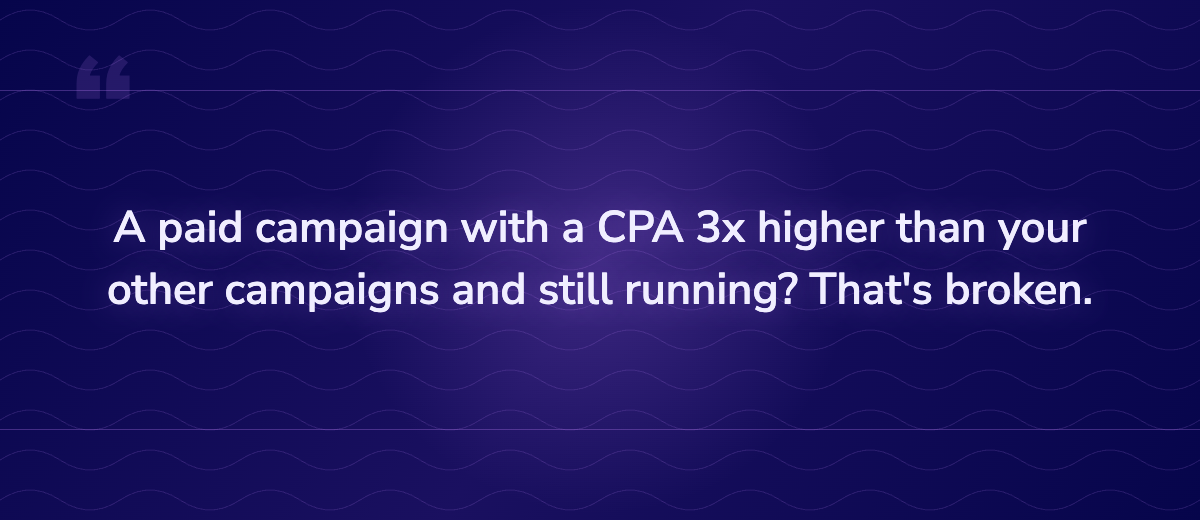
- Broken (things that are provably not working: tracking errors, broken conversion flows, underperforming campaigns spending real money)
- Opportunity (things that could work better: underoptimized pages, underfunded channels, messaging gaps)
- Hypothesis (things that might be problems but need testing: UX friction points, audience segments, content gaps)
- Noise (things that look like issues but are either too small to matter or outside your control)
Spend hours thirty-seven and thirty-eight building a priority matrix. On one axis: estimated impact (revenue, conversion rate lift, cost savings). On the other axis: effort required (hours, budget, dependencies). Plot every "Broken" and "Opportunity" item.
The tradeoff here is that impact is always an estimate, especially for conversion rate lifts. Studies from CXL Institute suggest the average A/B test lifts conversion by less than 5%, but teams consistently estimate 15-20% improvements. Adjust your expectations accordingly. If you think a change will lift conversion 10%, plan for 3-5% and you'll be closer to reality.
High-impact, low-effort fixes go first. These are usually:
- Pausing underperforming ad campaigns or ad groups bleeding budget
- Fixing tracking or attribution gaps that are obscuring good performance
- Improving high-traffic, low-converting pages with clear UX issues (broken mobile layouts, slow load times, unclear CTAs)
- Reallocating spend from saturated channels to underfunded ones that are showing efficiency
- Refreshing ad creative that's showing decay
- Optimizing landing pages for your top campaigns
- Launching targeted email sequences for high-intent segments (trial users who haven't converted, demo requests who didn't book)
- Expanding into a new channel that competitors are using successfully but you haven't tested
Hours thirty-nine through forty-two are for building your 30-day sprint plan. Pick three to five initiatives from the priority matrix. For each one, document:
- What you're changing: Be specific. Not "improve ad performance," but "pause the three ad groups with CPA over $150, reallocate $8K to the two groups with CPA under $60."
- Why it matters: Tie it to a business outcome, revenue, CAC, conversion rate. Avoid vanity metrics.
- How you'll measure success: Define the baseline metric and the target. If you're optimizing a landing page, the baseline is current conversion rate over the last 30 days. The target is a 15% relative lift (if baseline is 4%, target is 4.6%).
- Who owns it: Name a person, not a team.
- Dependencies: What needs to happen first? Does design need to be involved? Do you need developer time?
Hours forty-three through forty-six are for stakeholder communication. Write a two-page summary, not a 40-slide deck. Use this structure:
- Where we are: Top-line metrics, current funnel performance, CAC and LTV by channel
- What we found: Three to four key insights, each with a specific example or data point
- What's broken or underperforming: The "fix now" list with estimated cost of inaction
- What we're doing next 30 days: The sprint plan with owners and success metrics
- What we're not doing yet and why: The backlog with brief rationale for deprioritization
Spend the final two hours (forty-seven and forty-eight) setting up tracking for the next 30 days. If you're changing ad campaigns, note the current performance in a spreadsheet with date stamps. If you're optimizing a landing page, take screenshots and record baseline metrics. If you're shifting channel spend, document current allocation and results.
Create a lightweight weekly check-in format. Four metrics: what changed this week, what the data shows, what's working, what needs adjustment. Don't wait 30 days to review; course-correct weekly.